
A structural condition audit is an engineering assessment of an existing structure's current state. Whether you are responsible for a mine headgear, a road bridge, a reservoir, a substation gantry or a warehouse portal frame, at some point you need a defensible answer to a simple question: is this structure still fit for the job we ask of it, and for how long? The document that answers that question is the structural condition audit report. In South Africa, too many of these reports are little more than a folder of photographs with a handful of captions. That is not an engineering deliverable, and it will not protect you when an insurer, a regulator or a board asks how you knew the asset was safe.
More than a folder of photographs
The core problem is a confusion between capture and assessment. A drone flight, a set of high-resolution images or even a 3D laser scan is data. On its own it tells you what a surface looks like, not what it means. An audit turns that data into an engineering judgement: which cracks matter, which spalling is cosmetic, which staining signals corrosion of the reinforcement below, and what all of it implies for the remaining service life of the structure. If your report stops at pictures, you have paid for the easy half of the job and been left to make the hard decisions yourself.
What a structural condition audit report should contain
A report you can act on, and defend, should contain the following as a minimum:
- The date and scope of inspection. What was assessed, what was not, and when. Scope boundaries are as important as findings, because they define the limits of the opinion.
- The condition of the elements assessed. A clear, element-by-element statement of state, not a general impression of the structure as a whole.
- Located and photographed defects. Every defect tied to a position on the structure and evidenced, so it can be found again, monitored and repaired.
- A residual-life or fitness-for-purpose view. The engineering answer to whether the structure can keep doing its job, and for roughly how long under current loading.
- A repair methodology. How the identified defects should be put right, in enough detail to inform a rehabilitation plan.
- Material quantities for the repair. The measured quantities a contractor and quantity surveyor need to price the work, rather than a vague call to "repair as required".
- A stated accuracy class or level of detail. An honest statement of how precise the survey and model are, so you know which decisions they can safely support.
- Cross-references to applicable codes. The relevant standards for your asset, whether SANS, TMH or EN, so the assessment sits against a recognised benchmark.
- A named, registered Pr Eng sign-off. A specific Professional Engineer who takes responsibility for the findings and signs them.
The accuracy class deserves particular attention. A report that quietly leaves it out is asking you to trust conclusions without telling you how firm the underlying measurements are. A stated level of detail tells you whether you are looking at a screening review or a survey precise enough to design and cost a rehabilitation against.
A worked example: the Kolobeng Bridge
To make this concrete, consider the Kolobeng Bridge condition assessment. The structure was a 60 metre bridge, roughly 30 years old. The brief was not to photograph it but to establish whether it could be rehabilitated and at what cost, which meant looking past the surface. Ground-penetrating radar mapped the reinforcement without breaking the concrete, and a small number of concrete cores established the actual compressive strength. Combining non-destructive testing with targeted sampling like this is what separates an informed assessment from a surface inspection.
The output was not a slideshow. It was a level of detail 300 model with annotated, quantified defects that a design team could price for rehabilitation. Site mobilisation and primary capture were completed in a single day, which for an asset owner means less disruption, less time spent in a hazardous environment and a faster route to a costed decision.
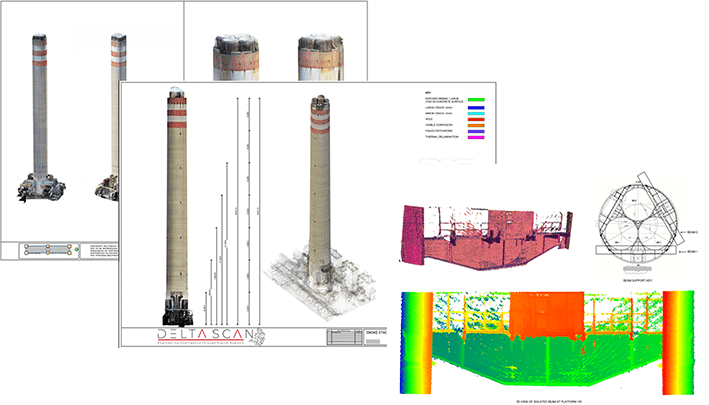
The anatomy of a condition audit report
A report that contains these parts is an engineering deliverable. One that stops at photographs is not.
| Section | What it should contain |
|---|---|
| Scope and date | What was inspected, when, and by whom |
| Condition findings | The state of each element, with located and photographed defects |
| Residual life | A fitness-for-purpose or remaining-life assessment |
| Repair methodology | How each defect should be remediated |
| Material quantities | Quantified inputs so the repair can be costed |
| Accuracy and standards | The stated accuracy class and the codes referenced (SANS, TMH, EN) |
| Sign-off | A named, registered Pr Eng signature |
Why the Pr Eng sign-off is the part that counts
Everything above is only as good as the person who stands behind it. A structural condition audit is an engineering opinion on safety and residual life, and that opinion carries weight only when a registered Professional Engineer signs it. Delta Scan combines drone and 3D laser capture with defect detection, and a registered Pr Eng reviews every finding before the report is signed. On Delta Scan reports that engineer is Darryl Epstein, Pr Eng, ECSA 202001436. The signature is not a formality. It is the difference between a document your insurer, your board and the regulator will accept and one they will not.
The same discipline applies whether Delta Scan acts as your engineer of record, or provides white-label capture and reporting to another engineering firm that signs off under its own registration. The deliverable is the same: findings an engineer is prepared to put their name to.
Three questions to ask before you commission an audit
Before you appoint anyone, ask three things. Will the report state an accuracy class or level of detail? Will it reference the codes that apply to your asset, such as SANS, TMH or EN? And will it be signed by a named, registered Pr Eng? If the answer to any of these is no, you are buying photographs, not an audit.
Delta Scan's structural condition audits are built to answer the fitness-for-purpose question in writing, with located and quantified defects, a repair methodology, measured material quantities and a signed engineering opinion you can act on. If you are responsible for ageing infrastructure and need a report that will hold up, that is where to start.