South African silos hold some of the most valuable and most hazardous material in heavy industry. Grain at the ports and inland handling sites, cement clinker and finished product, mining mineral storage, sugar, and industrial process silos all share one awkward trait: they are difficult and dangerous to inspect, so problems tend to be found late. A silo that fails does not fail quietly. It can injure people, bury stock, stop production, and become an insurance claim measured in months. That is why booking a silo inspection is really a decision about timing: catching deterioration while it is still a repair, not a collapse.
The difficulty is that a silo hides its condition. The liner, the discharge, the roof internal, and the material flow behaviour all sit inside a confined space that is expensive and risky to enter, so operators often run on the assumption that no news is good news. These are the signs that a silo needs inspection now, not at the next convenient shutdown.
Six signs a silo needs inspection
1. Visible cracking or spalling of the concrete
Cracks and spalling on a concrete silo are the most obvious external symptom, and the easiest to dismiss as cosmetic. They rarely are. Cracking can reflect overstressing of the wall, reinforcement corrosion pushing the cover off, or thermal and shrinkage effects. Spalling exposes the steel that holds the wall together. Once you can see it from the ground, the question is not whether to inspect, but how far the deterioration has already travelled through the section.
2. Corrosion or distortion of the steel plate
On a steel silo or bin, corrosion and distortion of the plate are direct measures of remaining strength. Rust staining, pitting, buckled plate, or a wall that no longer sits true all point to loss of section or loss of shape. Both matter, because a silo wall carries its load through geometry as much as through material. A plate that has thinned or deformed is doing less work than the design assumed.
3. Leaks, bulging, or ovality of the wall
A wall that leaks, bulges, or has gone out of round is telling you the structure is being loaded in a way it was not built for. Ovality in a circular silo is a particular warning, because a round wall relies on staying round to carry pressure evenly. Bulging and leaks can follow from blockage, from wall damage, or from stored material behaving differently to design, and none should be watched from the outside indefinitely.
4. Blockages, rat-holing, or flow problems
Flow problems are usually treated as a production nuisance, but they are also a structural signal. Rat-holing, arching, and stubborn blockages change how material bears against the wall, and clearing them by force can do more damage than the blockage itself. Recurring flow trouble is a good reason to look inside before someone is sent in to break a blockage loose.
5. Damage after over-pressure or an explosion
Grain and dust silos carry a real explosion risk, and any silo can suffer an over-pressure or impact event. After one, the structure needs assessment before it goes back into service, without sending people into a potentially compromised confined space. The internal condition, the extent of the damage, and the integrity of the roof and discharge all need to be established before the silo carries a full load again.
6. Time since the last baseline
The quietest warning sign is simply the passage of time. If a silo has never had a proper baseline inspection, or the last one is a distant memory, there is no record to measure change against and no early warning of slow deterioration. A first baseline turns an unknown into a documented starting point, and every inspection after that measures the trend, so you plan and budget for repairs rather than react to a failure.
Six warning signs and what they can indicate
None of these means a silo will fail tomorrow. Together they tell you when an inspection is overdue.
| Warning sign | What it can indicate |
|---|---|
| Cracking or spalling of concrete | Reinforcement corrosion or overload |
| Corrosion or distortion of steel plate | Loss of wall thickness and capacity |
| Bulging, ovality, or leaks | Wall movement, or pressure the shell was not designed for |
| Blockages, rat-holing, or flow problems | Internal wear, build-up, or structural change |
| Damage after over-pressure or an explosion | Hidden structural harm that needs assessment |
| Time since the last baseline | Undocumented deterioration accumulating unseen |
Why internal inspection is the hard part
Every one of these signs leads to the same question: what does the inside look like? Historically, answering it meant confined-space entry, one of the most dangerous tasks on any site. Entry brings atmospheric hazards, dust, engulfment risk, and working at height inside a structure whose condition is the very thing in doubt. It is slow, costly, and puts people into the hazard.
Delta Scan removes that trade-off. We fly collision-tolerant drones inside the silo to capture wall condition, blockages, and damage in 3D, with no human entry into the confined space, and we assess the exterior structure as well. The interior becomes measurable 3D a structural engineer can work from, not a handful of photographs taken through a manhole. Because the same approach reaches other enclosed structures, it sits alongside our wider confined-space inspection work on tanks, flues, and vessels.
What a signed silo inspection delivers
Capture is only useful if it ends in an engineering judgement. A Delta Scan silo inspection is a structural condition audit signed by a registered Professional Engineer, Darryl Epstein (Pr Eng, ECSA 202001436). That signature is the difference between a set of images and a document your team, your auditors, and your insurers can rely on.
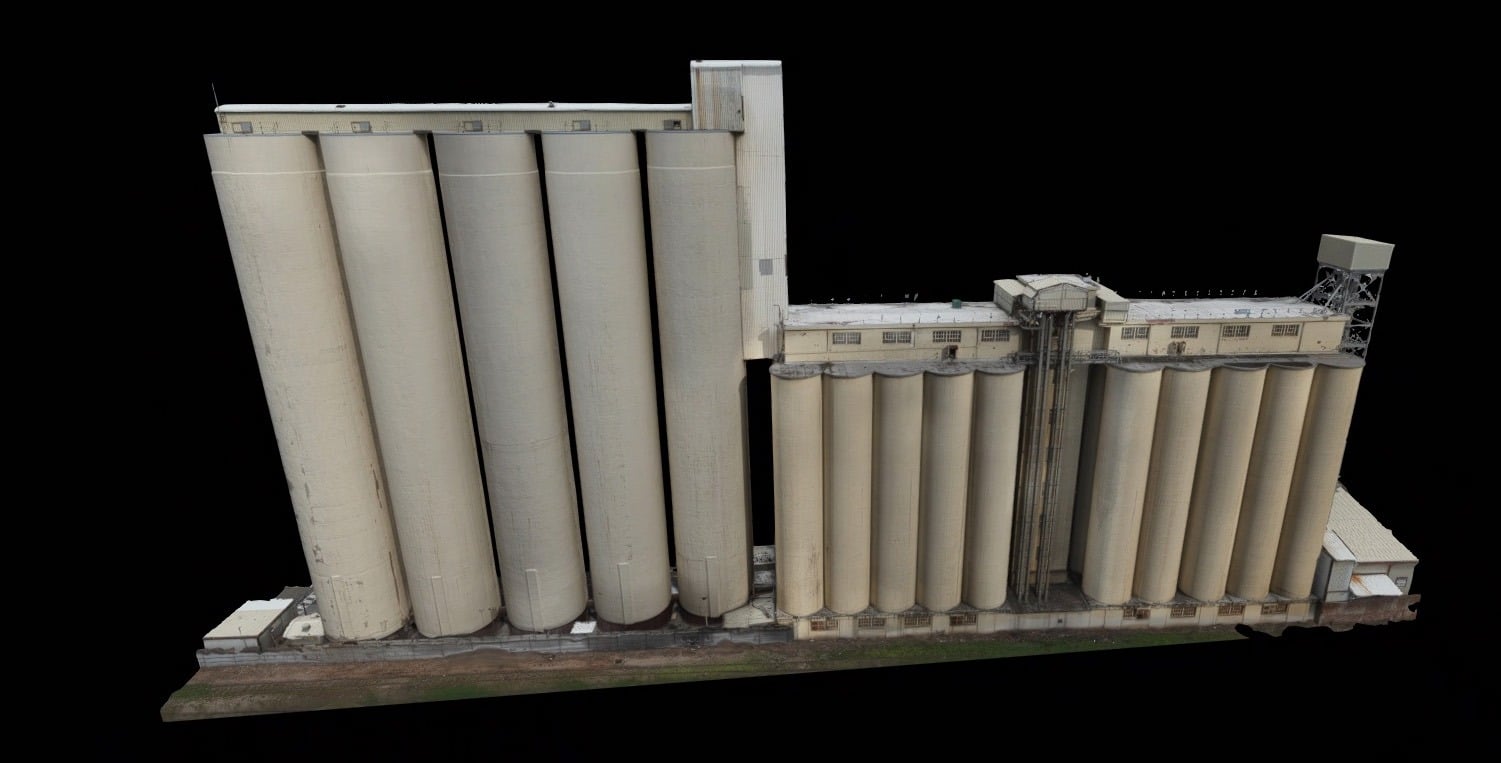
The approach is proven on South African assets. We have run a baseline visual inspection of a Durban silo array covering 35 silos and 16 inter-bins, and we carry out annual baseline inspection of mine storage silos using drone capture and a digital twin, so each year measures change against the last. That turns inspection from a grudge cost into a planning tool: a condition trend that tells you what to fix, and when.
Do not wait for the failure
If your silo is showing any of these signs, or you cannot remember its last proper baseline, the sensible step is to look inside before it forces the issue. Delta Scan captures the whole silo, inside and out, with no confined-space entry, and hands you a Pr Eng signed condition assessment you can act on. Learn more and request an inspection on our silo inspection page.