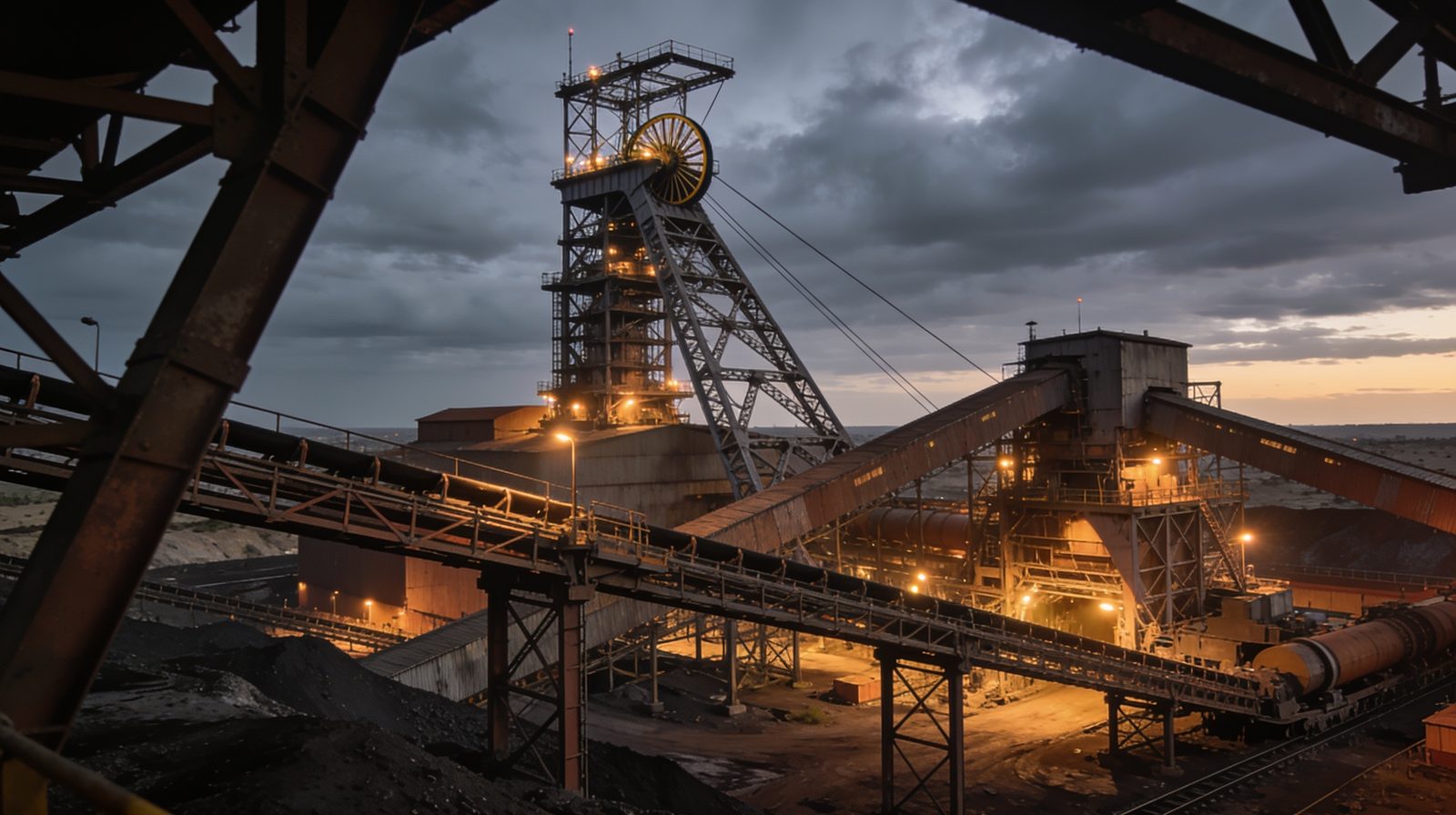
On most South African mines, the safety of the plant steel, headgear, conveyor gantries, bins, and silos is managed through a structural inspection and maintenance programme built on the SIMM framework. SIMM stands for Structural Inspection and Maintenance Management. It grew out of Anglo American's technical standard for plant structures (AA TS 108 003, the SIMM Guideline for Plant Structures) and has been adopted or adapted across much of the industry as the common language for structural condition.
If you are responsible for structures on a mine, a SIMM audit is the backbone of discharging that duty. This article explains what one actually involves, so you know what to expect and what a good audit should deliver. For the full rating tables, see our SIMMS audits page.
Why SIMM exists: the duty of care
The Mine Health and Safety Act (Act 29 of 1996) places a duty on mines to keep their structures safe, and each mine's code of practice defines how structural inspection and maintenance is managed. Several structural failures at plants over the years, some with fatalities and large financial losses, could have been prevented by properly implemented structural maintenance. A SIMM programme is the accepted way of finding deterioration early and rectifying it before it becomes a failure.
It is worth being clear about scope. A SIMM inspection is primarily a visual assessment of condition. It is a best-practice precautionary measure for the early identification of structural deterioration, not a certification of structural adequacy. That is exactly why the reporting, categorisation, and follow-up discipline matter so much.
The six condition categories
Every structure or member inspected is assigned one of six condition categories, from 0 to 5. The category reflects how much of the original structural strength remains, and it drives both the repair response and how soon the next inspection is due.
- Category 0 and 1 cover excellent or lightly weathered structures with no reduction in strength. Safe use is assured.
- Category 2 and 3 cover slight to real reductions in strength. Category 3 should enter maintenance scheduling for planned repair.
- Category 4 is severe deterioration with a major reduction in strength. Safe use of the plant is compromised and repair is urgent.
- Category 5 means little useful residual strength, or a member so hidden by spillage that its condition cannot be assessed. Safe use is impossible.
The important discipline sits at the top of the scale. Category 4 and 5 findings are critical: the guideline expects them to be raised with the plant engineer on the day of discovery, with immediate risk mitigation such as propping, load reduction, barricading, or a production stop put in place within 24 hours. A good auditor flags these on site, not weeks later in a report.
Condition categories at a glance
The full six-category and priority tables sit on our SIMMS audits page. This is the short version.
| Category | What it means | Typical response |
|---|---|---|
| 0 to 1 | No reduction in strength | None required |
| 2 to 3 | Slight to real reduction in strength | Plan the repair into maintenance |
| 4 | Major reduction, safe use compromised | Urgent repair |
| 5 | Little residual strength, unsafe | Immediate mitigation, then urgent repair |
The five repair priorities
Every remedial action the audit recommends carries a priority, so the maintenance team knows what must happen first and what can be scheduled. In short: Priority 1 is urgent, immediate attention (all category 5 members and primary members at category 4). Priority 2 is within one year. Priority 3 is within three years and scheduled into the maintenance plan. Priority M marks defects to be monitored before the remedy is decided, such as recurring loose bolts or cracks whose growth rate is not yet known. Priority X marks structures that must not be used until repaired and signed off. The full priority table is set out on our SIMMS audits page.
Three kinds of inspection, and how often
A SIMM programme layers three inspection types:
- An ordinary visual structural inspection by a trained structural inspector, covering every primary, secondary, and tertiary member, area by area. Good practice is at least once a year.
- An engineering visual structural inspection by a structural engineer, examining all primary members in detail plus a representative sample of the rest, and reviewing the inspector's findings, thickness measurements, and any non-destructive testing. This is carried out within two years of commissioning, then at condition-driven intervals never exceeding five years.
- A special structural inspection for targeted measurement: thickness surveys on tanks and bins, crane rail alignment and magnetic particle inspection of crane girders, vibration assessment, or checks after a seismic event or vehicle impact.
Cadence is condition-driven. The worse the plant's condition, the shorter the interval, until repairs bring it back to category 3 or better. A plant with its worst structures at category 5 may need a full engineering re-inspection every six months, while one sitting comfortably at category 1 to 3 can run on a five-year cycle. Systematic capture and early repair therefore reduce how often the whole plant must be re-inspected, which is a direct cost saving.
What reality capture adds to a SIMM audit
Traditional structural inspection on a mine relies on what a person can reach from the ground, a ladder, or rope access. That is slow, hazardous, and inherently sample-based. High steel, no-access areas, and confined structures like bins and bunkers are exactly where deterioration hides.
At Delta Scan we run the SIMM audit as a signed structural engineering service, with reality capture doing the legwork. Drones cover high steel and no-access areas, confined-space capture reaches internal structures without human entry, and 3D scanning produces a measurable record of the geometry. The result is that the condition assessment is grounded in complete coverage rather than what could be seen from a ladder, every defect is located on measurable geometry, and the next audit cycle can measure change against the last one instead of starting from scratch. A registered professional engineer reviews and signs the findings.
What a good SIMM audit should deliver
By the time the audit closes, you should have: a condition category for every structure inspected; all category 4 and 5 findings flagged and mitigated on the day; a prioritised list of remedial actions with required dates; and a signed record that your auditors, insurers, and the regulator can rely on. The measurable capture record then becomes the baseline for the next cycle.
If your structural audit cycle has slipped, or a shutdown is coming and you need precise repair scopes, a capture-assisted SIMM audit re-establishes the baseline across the full structure register quickly. Before booking, it helps to work through our SIMM audit readiness checklist. You can request a SIMMS audit proposal, or read how we approach mine shaft inspection and silo inspection.